
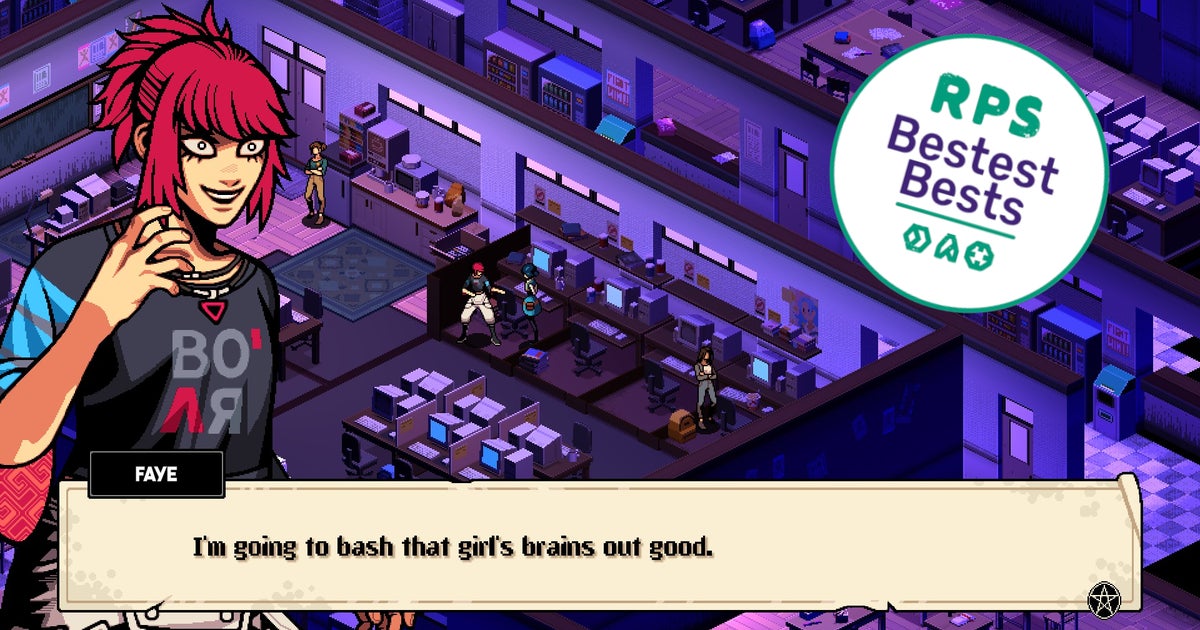
To say that Demonschool comes out swinging with its premise would be an understatement. Trapped on the isolated Hemsk Island and surrounded by increasingly spooky occurrences, it quickly becomes clear that Faye and her classmates have no choice but to kick demons’ spines out, pass their semester without going to prison, and face the greatest horror of all: making friends in university.
A turn-based tactics RPG with as heavy a focus on lining up demons and knocking them down as building up bonds with party members, Demonschool grants you ten weeks to stop the apocalypse and have some fun along the way. The tone is light across the board, with students, gangsters, and the school staff regarding their impending doom with a similar degree of concern to a group presentation deadline.
Demonschool excels at one of the trickiest elements to nail in a story like this: making the jokes actually funny. It’s bursting with tiny gags, sometimes as simple as one-two punches of character names and dialogue — an understated highlight was a yakuza named Tiny Gangster muttering “Hold me closer” to himself. Interactions between the party are consistently witty enough to make you at least crack a smile if not embarrassingly snort, with particular compliments to Faye’s unhinged sapphic aggressiveness towards just about everything (equal in love and in violence) and Destin’s repeated, adorable inability to grasp the severity of the school’s situation. With worse writing, this style of humour could easily tip over the edge from breakneck wit to cliche trite, but Demonschool manages to keep the comedic momentum up without going too far and making caricatures of its characters. More than anything, Demonschool is just relentlessly charming.

As the conspiracy at the heart of Demonschool’s narrative unfolded, with patriarchs returning from beyond the grave and eldritch nightmares summoned by demonic rituals, I was at one point struck by a sudden realisation: this story has the same vibe as a season of Scooby-Doo. I mean this as a great compliment. Hell, there’s literally an ‘artifact-of-the-week’ structure to each weekly cycle, placing Hemsk Island Incorporated on wild goose chases to find/repair items adjacent to the prophecy, inevitably facing a horrifying boss battle to acquire them and end each week.
Speaking of battling, the combat system is how you’ll be spending the majority of your time. Despite laying its cards out on the grid fairly early on, the depth, difficulty, visual flair, and efficiency of it all guarantees you’ll always be finding new strategies and struggling in novel ways throughout. Four party members enter the fray, with the AP cost of each party member’s move steadily increasing within each turn, forcing choices on not just which abilities to use, but when. Varying greatly between characters in their utility, special attacks earned by attacking or healing are powerful enough to turn the tide in one turn (and thus instill a sense of dread when you realise your actions in one turn don’t quite fill up the special bar you needed).
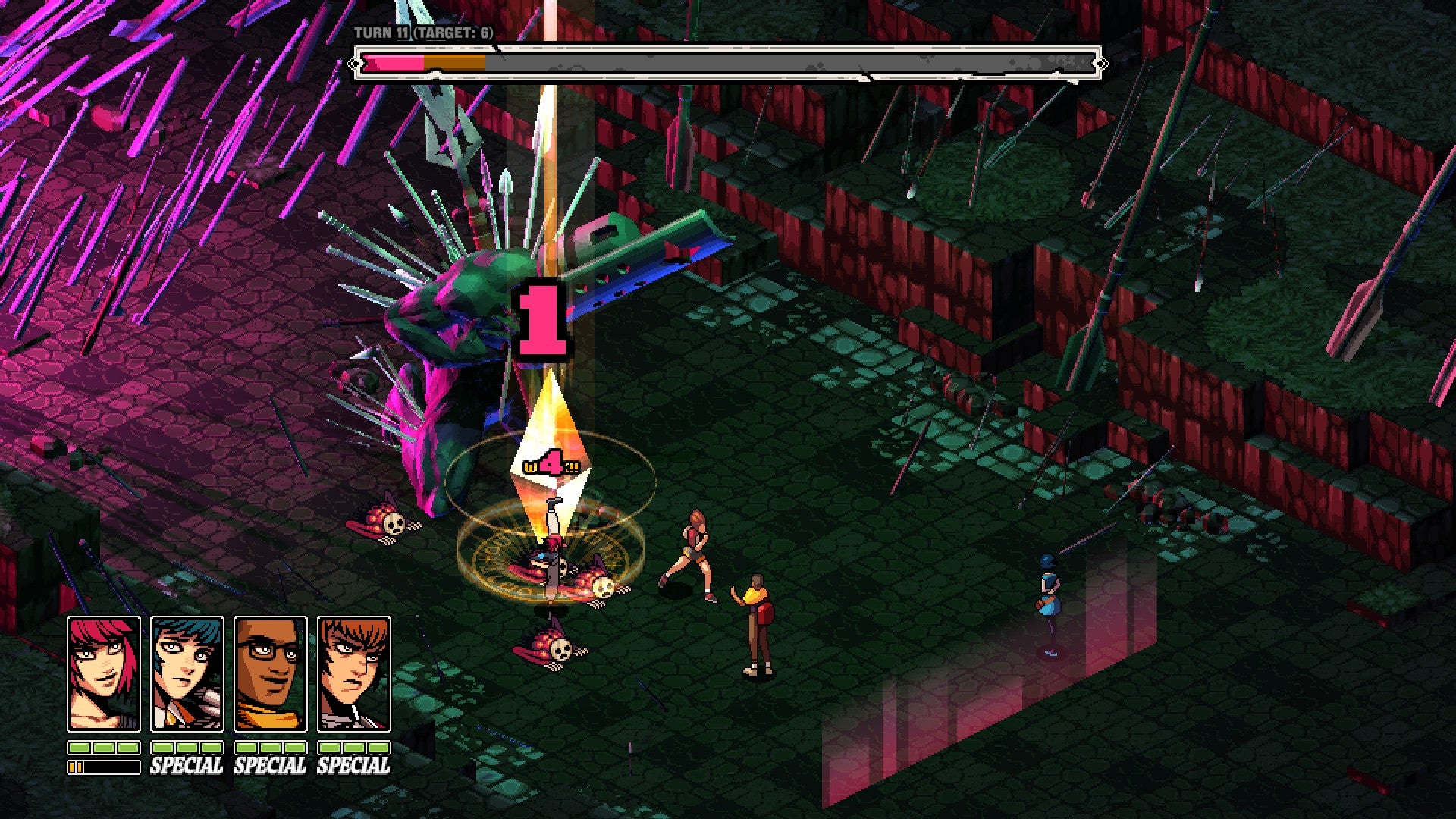
Demonschool starts off easy, even for someone new to the tactics subgenre like me, but will happily kick your teeth in later if you’re on autopilot. Even with the infinite time granted for decisions in each turn, I still often found myself biting my lip and praying that I hadn’t just made a terrible mistake as soon as I committed to the turn (and then watching my party perish for my hubris, obviously). Performance in combat, judged by the mortality of your party and reaching the sealing phase to end battles under each fight’s pre-established turn par, also decides the amount of medals received, which are spent on unlocking character modifiers. Thankfully, Demonschool is kind enough to include the ability to freely undo and redo actions until you’re sure you want to commit to that turn, as well as restart battles at any time to use your acquired knowledge to make better choices from the start (or immediately restart after finishing, if your initial rank is poor).
Demonschool rounds out at 15 party members, granted gradually throughout the narrative as Faye and co. manage to convince classmates to join their club with increasingly absurd motivations. Cinnamon-sweet Mercy, for example, joins up after finding an adorable canine familiar, but quickly realises she might not be up to ‘fighting giant skeletons and stuff.’ There’s a risk of the sheer size making the party feel less than the sum of its parts, through having less space to focus on each member in narrative and divergent battle synergy, but Demonschool sidesteps this effortlessly by giving each student a specialised role.
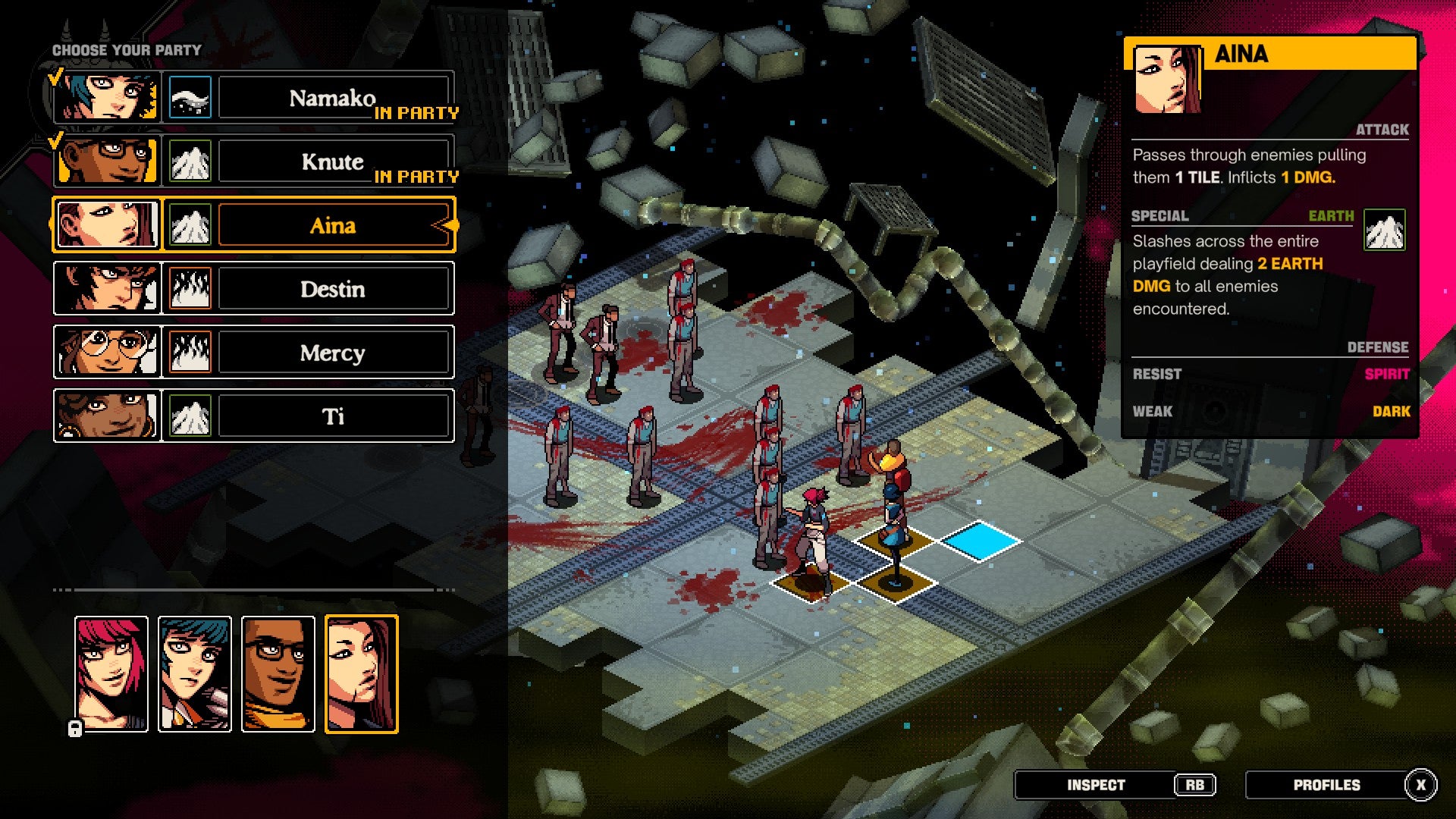
Even with a relatively small selection of elements assigned at one per character – Almighty, Flame, Earth, Flood, Ice and Metal – there’s no overlap between roles, and each party member has something entirely unique to offer within the team of four that goes into battle. Namako and Aina might both attack by phasing through enemies and swapping places, but where Namako debuffs and stuns to set up another classmate’s attack, Aina slices clean through demons with a graceful violence. Even the resident healer and pacifist Knute plays around with the archetype: healing an ally with full health will instead buff their damage, giving reason to really think about whether to mend your wounded or go scorched earth with a damage dealer like Faye or Destin. This is complicated further by the techniques and aspect shifts unlocked via awarded medals or opal (the standard currency), which alter character traits in avenues as standard as doubling knockback, or as game-changing as allowing them to inexplicably loop around to the other end of the grid.
You can, by all means, run through the game with a party of personal preference — I kept a ‘comfort’ team of Faye, Aina, Destin and Knute as my default for some time — but enemy weaknesses, initial enemy placement, and their attack properties mean you should often take a minute to think about who is truly best for the fight that lays ahead. Despite all of the complexity in synergy that Demonschool offers, I’ve no shame in admitting that nothing made my neurons fire quite like the simple kineticism of watching Faye’s special attack send enemies flying across the grid, exploding into blinding pillars of almighty light. Listen, you show me a cute and intimidating girl kicking a line of incompetent yakuza into the ether, and you’ve sold me on your game.

There’s far more than just combat in Demonschool, though – why have a party if you can’t spend time with them outside of kicking demon ass? While some side activities are quite simple, like cooking and fishing (discounting the unholy biology of Hemsk’s marine life), others add unique twists to established RPG minigames. Like a Dragon’s karaoke is a rhythm game, but Demonschool’s rendition tasks you with identifying a lyrical theme and selecting the matching verses with great haste. Demonschool also takes a leaf out of Like a Dragon’s book by including a few of Necrosoft’s older titles as games-within-a-game, playable on arcade machines in the party’s clubhouse. A favourite of mine is visiting a physical tape collector with movie buff Knute and picking out a (real) classic film, who’ll watch it in his downtime between demons and write a short review for the university paper. What’s wonderful is that you can actually read these via the town square’s mailbox – it’s the difference between just saying Knute is a physical media purist and film critic, and showing it. Activities also raise bonds between the party, with friendships deepening, combat synergy improving, and the possibility of some becoming more than just friends.
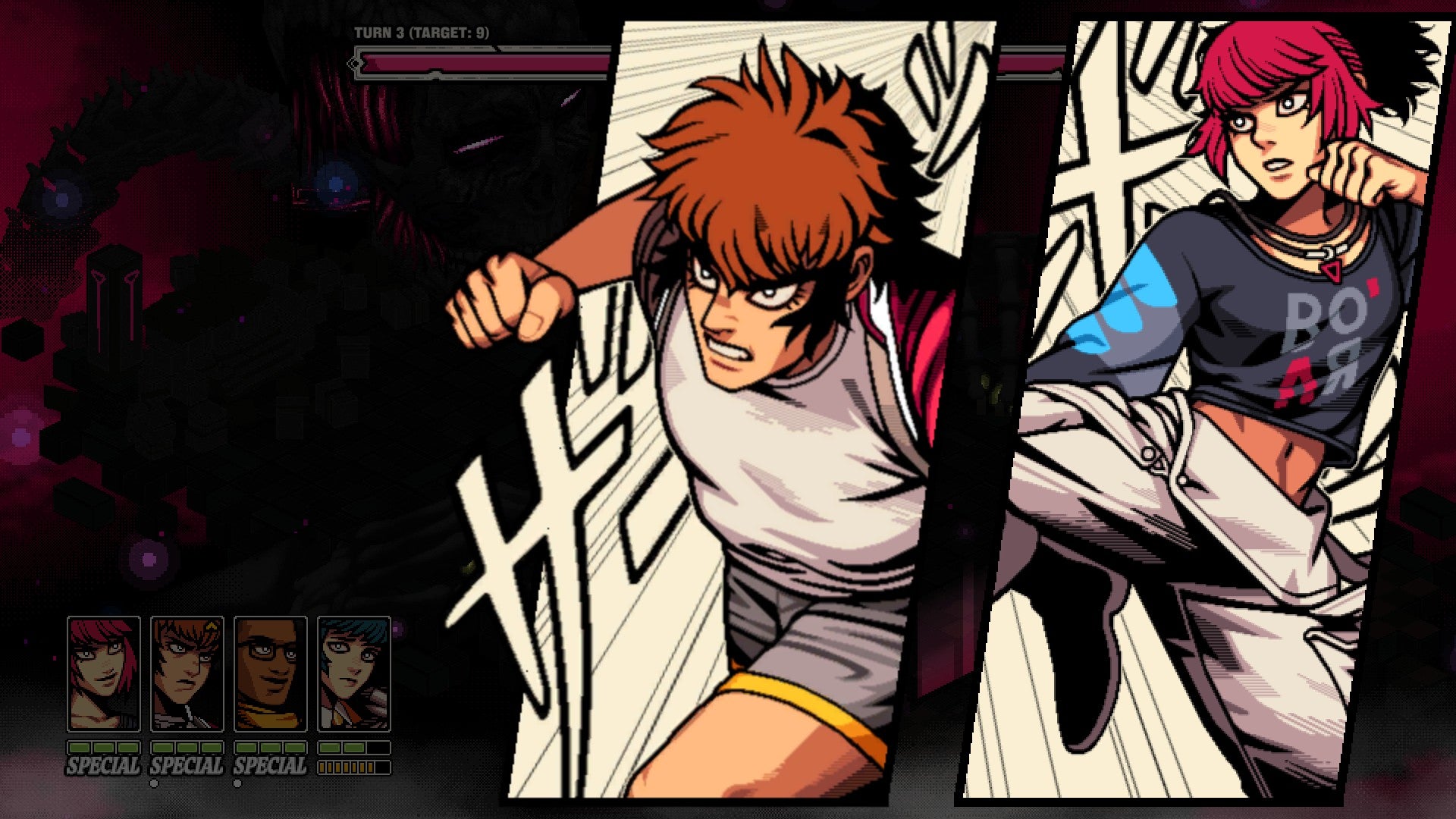
All of this is presented in a beautiful blend of stunning 2.5D pixel art, striking hand-drawn illustrations, and low-poly 3D models often cleverly reserved for bosses, making them look even more otherworldly and wrong. Necrosoft has noted design inspirations including Shin Megami Tensei, ukiyo-e prints, the work of Junji Ito, and even classic Italian horror such as Suspiria, and nowhere are these horrific touchstones clearer than in the bosses – I can’t say I’ve ever seen a skeleton recoil from an attack by popping out its brain in a torrent of blood. Special mention goes to the explosive manga-cutout impact panels that flash up on a successful combo attack, which add exciting visual flair and represent your party’s growing synergy perfectly.
Environments in and outside of battle are also a pleasure to just sit and take in the ambience of, which in turn necessitates mention of Kurt Feldman’s incredible soundtrack. Spanning upbeat, gentle tracks befitting the slice-of-life school setting and hard rock battle tracks to keep the blood pumping while toiling over your next turn, Demonschool’s soundtrack is dynamic in more ways than just its tonal variety. Instruments fall in and out of tracks as combat switches between planning and action, or as overworld travel transitions into key story scenes; it’s a real neat trick, and I can happily thank Feldman for having the Friday Battle (Action) track repeating in my head at any time I wasn’t playing.
Demonschool has a very clear intent in its design, and it succeeds in that intent with perfect marks. I adore the characters, setting, combat, side content, design, music, everything. As soon as I finish writing this, I’m going straight back to playing more of it. There’s just nothing that looks, sounds or plays quite like Demonschool, and I feel very fortunate to live in the same demon-free world as it.