
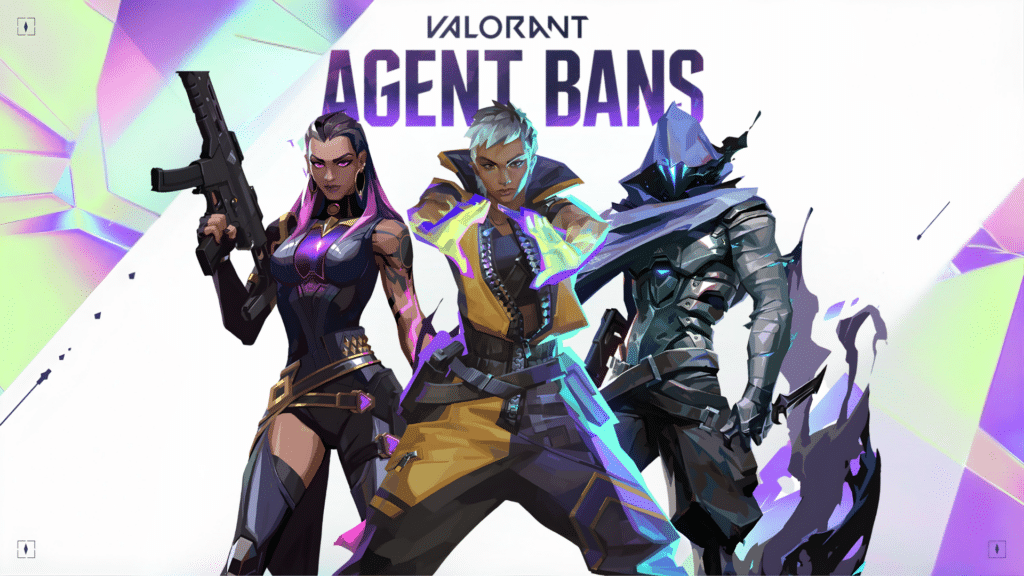
VALORANT has drastically evolved since its launch in 2020, not just in terms of agents, but also in how the game is played across different levels. There were 10 agents available at launch, each role was clearly defined, and compositions were easier to master and counter.
However, as the roster grew, roles started to overlap, for instance, Vyse has abilities of both a Sentinel and an Initiator. Combined with multiple meta shifts and the introduction of new agents, the long-standing debate around introducing agent bans in VALORANT esports now feels more relevant than ever.
- VALORANT Game Changers is struggling and Riot Games is the one that needs to save it
- “This is so unfair”: The problem with different VCT regions playing on different patches
Agent Bans Didn’t Work Before, But Make Sense Now
Back in the day, agent bans didn’t make sense as the pool was small enough and the meta was defined to the point that removing one key pick, such as Sova or Jett, could cause an entire composition to come crumbling down.
“We’ve considered a draft phase for agents, but the current thinking is that we would not have bans,” Trevor Romleski, Senior Game Designer for VALORANT, stated back in 2020.
“VALORANT doesn’t have hard counters in the form of agents (this isn’t our design philosophy), we think the game state is healthier if we’re held accountable to ensuring no agent or agent-facilitated strategy becomes so oppressive or unsolvable that a ban is the only choice,” he further added.
However, there are currently 29 playable agents in VALORANT, with more likely to arrive by the end of the year. On top of that, frequent meta shifts result in a few agents dominating while the rest rarely see the light of day, despite being decently viable.
“On a personal level, I hate the meta. I think it’s stupid that half the cast can’t be played. I don’t know why they would nerf Sentinels when last year, double-Duelist was the premier choice,” said Hector “FrosT” Rosario, Global Esports Head Coach.
It’s not like teams aren’t adapting, but the innovation is happening on a micro level rather than a macro one, which makes gameplay feel increasingly predictable. Moreover, there are players who have built their identities around specific agents, and over time, their strategies become easier to counter.
“VALORANT in its current state is more momentum-based than at any other time. Confidence swings and snowballing with ultimates make a lot of the games feel predictable,” Donnie “Elevated” Chell shared on X (Twitter).
Agent bans would directly address that problem as they would not only disrupt comfort zones, but will force teams to adapt in real time, showcase their actual depth, and ultimately raise the bar of competition.
Some would argue that it would invalidate the practice teams have put in, but the point is that, over the years, teams have played through multiple metas, preparing them to operate on a macro level. To summarize, teams will be tested not just on mastery but also on adaptability.
As former IGL of Shopify Rebellion Gold, Melanie “meL” Capone, stated: “VALORANT right now is dictated by how well you can dissect micro situations and gain an advantage. Taking favorable engagements + strong executes = king.”
Watching VALORANT Esports Has Started to Feel Stale
Plus, esports thrives on unpredictable moments, and agent bans would add another layer of hype while creating new storylines and narratives. At the moment, viewership across different leagues is steadily declining, as even fans are growing tired of the repetitiveness.
For example, VCT Americas Kickoff 2026 reached a peak viewership of only 370,608, compared with 553,837 for the previous edition, according to Esports Charts.
On the contrary, the match in which Team SMG picked four Duelists and a Sentinel on Lotus at VALORANT Game Changers Championship 2023, even though it was accidental, was so exciting that the community still talks about it even after two years. The roster adapted on the spot and defeated their opponents, Evil Geniuses GC, by 13-3 on that map.

Implementing Agent Bans Right Without Compromising Competitive Integrity
While the introduction of agent bans sounds exciting in theory, it’s equally important to implement the system carefully to avoid chaos.
For instance, it could be tested in off-season tournaments, such as the BoomTV VALORANT Select 2025, and refined to find the right balance before introducing it into VCT and Game Changers.
Starting with a single ban per team could be enough to assess the desired impact without disrupting game plans too much.
The goal with agent bans is to reap the benefits without degrading the level of competitive integrity that Riot Games has always been cautious about.
When I spoke to John Goscicki, Agent Lead at Riot Games, back in 2025 about this, he shared that while the game is in a pretty good state, as the agent roster grows, they might eventually have to “pull a different lever.”
Agent bans offer a way to introduce new challenges as the talent pool continues to grow, and with Riot Games continuously polishing VCT and bringing stability to VALORANT esports, this addition could further strengthen the evolution of its competitive scene.
The post “I hate the meta”: VALORANT’s meta is becoming predictable, and agent bans could be the answer appeared first on Esports Insider.